 Netherlands · Software Development · Marketplace & E-commerce
Software Development for Marketplace & E-commerce businesses in the Netherlands
Marketplaces are two products in one, supply side and demand side, and we have shipped both: matching logic, payments and escrow flows, seller dashboards, and the SEO architecture that makes listings rank.
Companies in the Netherlands work with us fully remotely: one founder as your point of contact, weekly demos, delivery on EU hours, everything in English.
 Murat Efe DoğanFounder, your only point of contact5.027+ verified reviewsCurrently accepting new projects
The startups & companies we build for










27+ verified reviews, 5.0 average
Every review below is from a real client on a real project, verified on the platform we were hired through.
 Holland
Murat is a professional I really enjoy working with. His communication and commitment makes the difference. Murat is always pro-active and eager to learn new technologies to support the progress of our projects.
 United States
Loved working with Murat, very knowledgable with NextJS and Supabase and was able to put together the project and iterate really quickly. Communication was great, very responsive and fast turnaround of changes requested. Would recommend for frontend projects and very pleasant to work with!
United StatesMurat was exceptional to work with. He really knows his stuff and was able to debug me out of the complete mess that I was in. His knowledge of Next.js and Firebase really came to the rescue. I highly recommend Murat and his services!
United StatesMurat has been AMAZING throughout the whole product cycle. The documentation was top-notch, and the attention to details and professionalism were truly impressive. Working with Murat was an absolute pleasure: cooperative, quick to respond, and fluent in communication. Excited for what comes next! 👍
 Denmark
It's a pleasure to work together! Our communication is clear, progress outstanding, and it's always a pleasure to meet and get updates. Happy that we're going to work together towards building a great SaaS product.
 Argentina
It is very fun to work with Murat. He's clearly experienced, pays attention to detail, and got very involved with the project. He completed the job very quickly and with high quality. Highly recommended :)
 Sweden
Pleasure working with Murat!
What software development includes
What software development means for Marketplace & E-commerce businesses
A marketplace is two products sharing a database, and the hard part is never the listing page. It is matching that produces a transaction, money movement that both sides trust, and a seller dashboard good enough that supply stays. We have shipped all three, including escrow flows and payouts, and we build the supply side first because a marketplace with demand and no inventory is just an empty page.
- Matching and ranking logic tuned for transactions, not for browsing time
- Payments with escrow, split payouts, refunds and dispute states
- Seller dashboard with listings, orders and earnings in one place
Work we have shipped for Marketplace & E-commerce businesses
Real, shipped work: screenshots, stack and results included.
 United States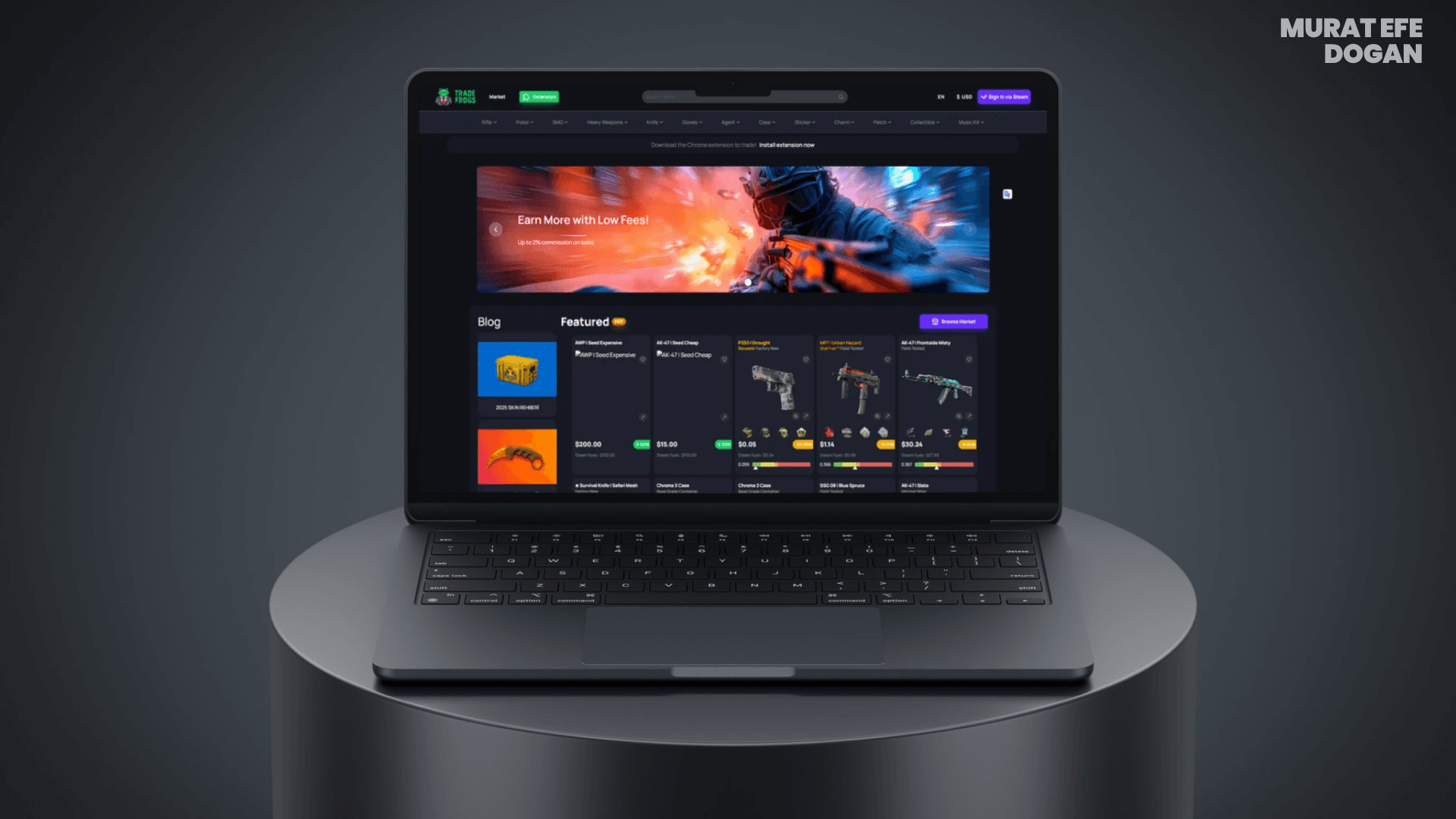
Trade Frogs
Trade Frogs is a peer-to-peer marketplace for trading CS2 (Counter-Strike 2) skins directly through Steam. With tiered commissions as low as 2–10% and a companion Chrome extension, traders buy, sell, and swap items securely while keeping more of every deal.
United States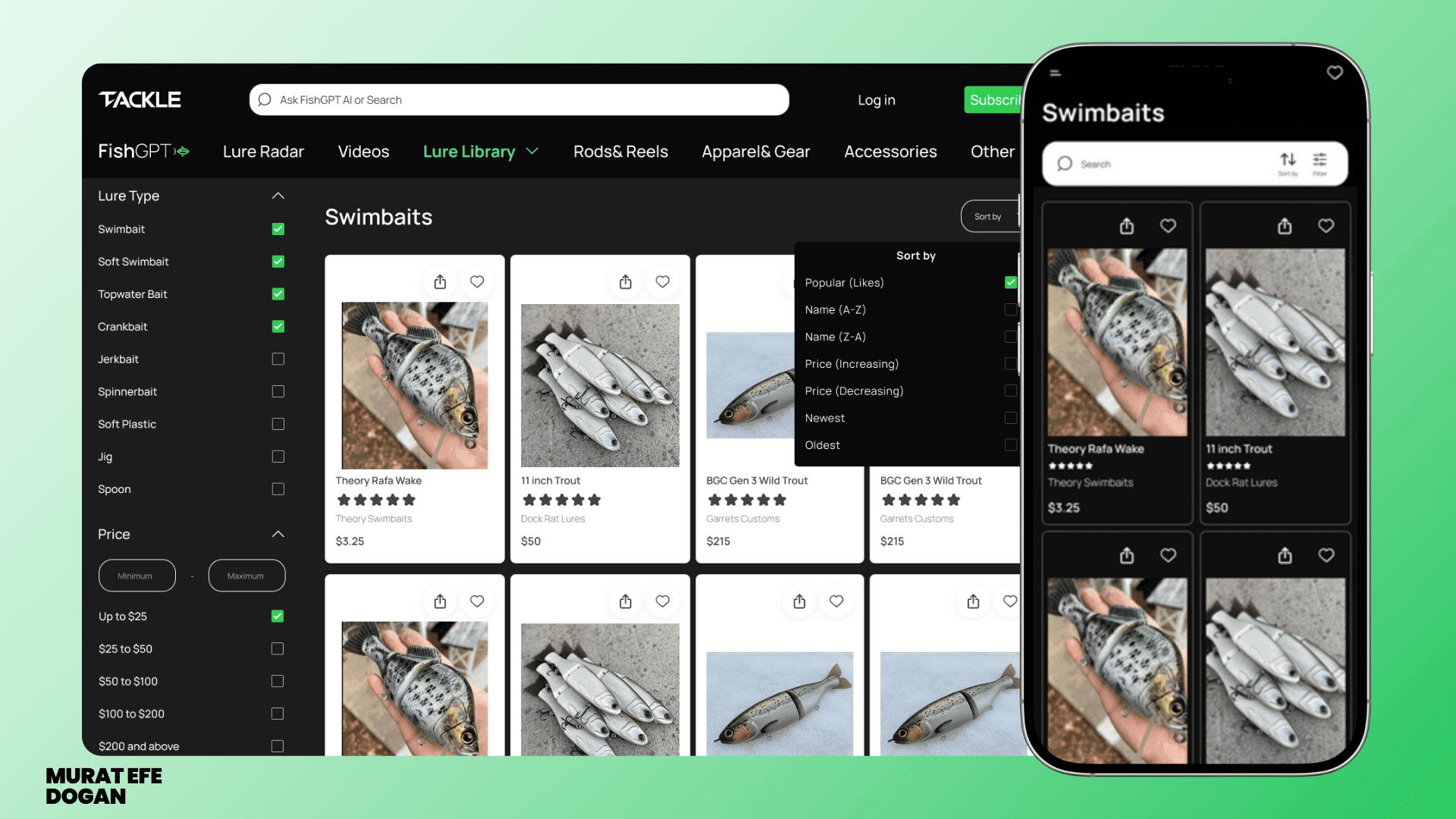
Tackle
The leading online marketplace for custom fishing lures and handmade baits, featuring 4,300+ lures from 520+ independent makers, AI-powered comparisons, and a real-time lure tracking radar.
 Norway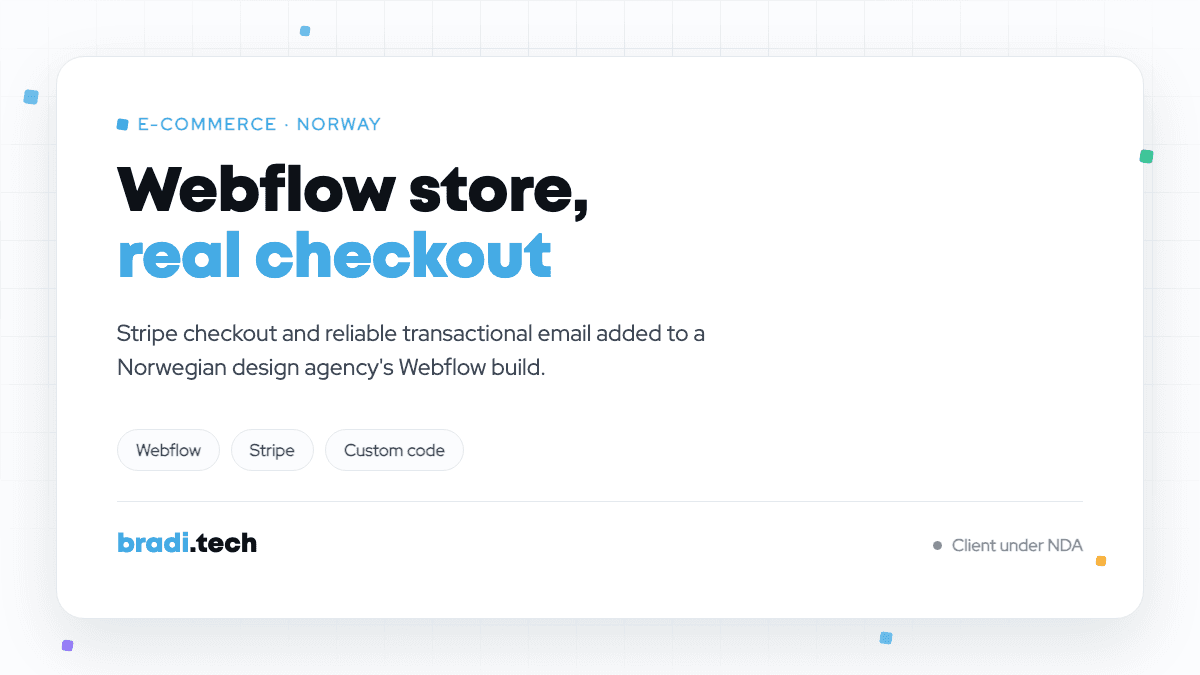
Webflow Store with Stripe Checkout
Work for a Norwegian website design agency: turning their Webflow builds into a working shop. I integrated Stripe with custom code and fixed the transactional email problems their setup could not solve alone.
United States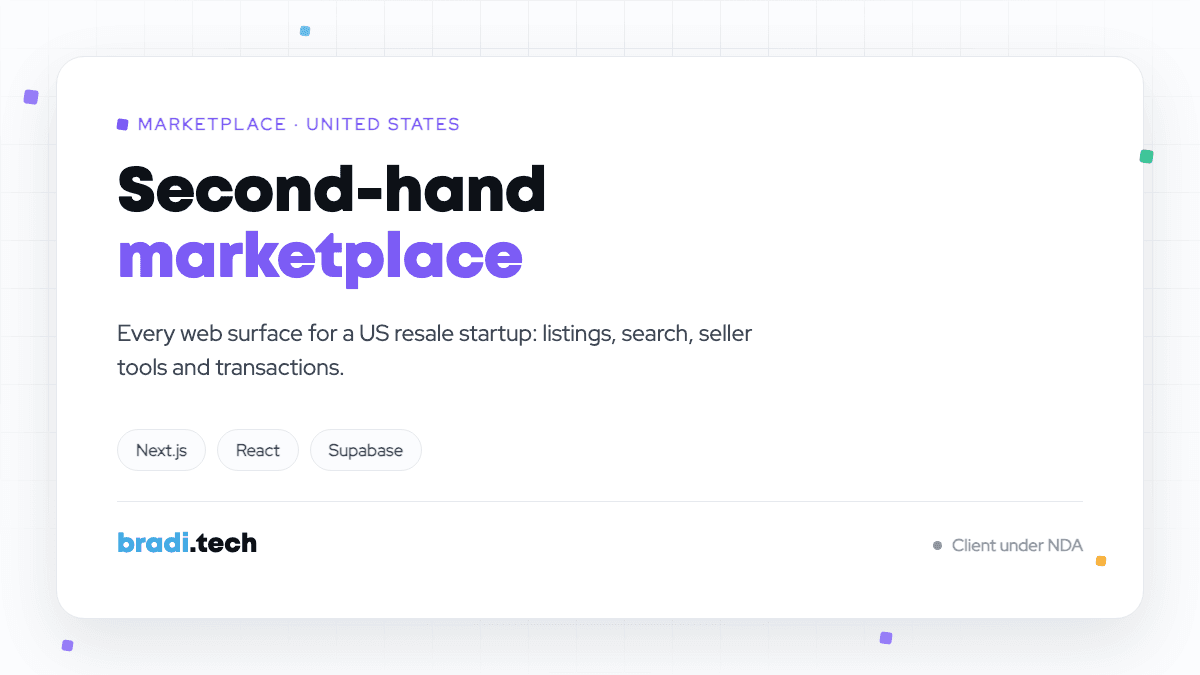
Second-hand Marketplace
The full web side of a US resale startup: a two-sided marketplace where people list, discover and buy second-hand items. I develop every web-based part of the product.
Working with bradi.tech from Netherlands
- Invoicing and VAT
- You are invoiced in euros from Türkiye, outside the EU, so no VAT is charged and there is no reverse-charge entry to make: it is a straightforward import of services for your accountant.
- Hours and language
- One hour behind Amsterdam, so the whole Dutch working day overlaps ours. Delivery runs in English, and we already operate a Dutch entity with a local partner through Rehome BV.
- What local costs
- A senior Next.js developer in Randstad agencies runs roughly 95 to 140 euros an hour, and an in-house hire lands near 75,000 euros plus employer costs.
- This market
- Dutch clients decide quickly and expect directness, which suits a weekly demo cycle: we have shipped e-commerce SEO builds and event platforms for Dutch companies and know how fast the feedback loop can move here.
Meet the person you'll work with
Two minutes on who we are, how we work, and what you can expect.
See a product we actually shipped
Qonnect is an NFC networking product we built for a Swiss founder, start to finish. Two minutes of the real thing, running in production.
Qonnect, built for a Swiss founder
Software Development by industry in Netherlands
Software Development in other countries
Software Development for Marketplace & E-commerce businesses in the Netherlands: FAQ
- Do you offer software development for companies in the Netherlands?
- Yes, we deliver software development for clients in the Netherlands fully remotely, as we do across Europe, North America and the Middle East. You work directly with the founder, see progress weekly, and everything runs in English on EU hours.
- Have you worked with marketplaces and e-commerce businesses before?
- Yes. Marketplaces are two products in one, supply side and demand side, and we have shipped both: matching logic, payments and escrow flows, seller dashboards, and the SEO architecture that makes listings rank.
- What does software development cost in the Netherlands?
- We price per project, not per hour, and as a senior remote team we are usually well below local agency rates for the same stack and seniority. The intro call ends with a concrete quote, not a range.
- How fast can you start?
- Usually within one to two weeks of the intro call. A typical MVP ships in 4–8 weeks; a landing page in 1–2 weeks. You see working output every week from the first sprint.
- How do you deal with the cold start problem?
- By building the supply side first and making it usable before demand arrives, usually with seeded or concierge inventory and manual matching behind a normal-looking interface. That is deliberately unscalable at the start, and it is what gets the first transactions that make the automated version worth building.
- What happens after launch?
- Most clients stay on a monthly retainer for improvements and growth, which is where software development usually pays for itself. It is optional and month to month: the handover includes documentation good enough for another team to pick it up.
- How do you price?
- Per project, not per hour, so the incentive is to ship rather than to bill. You get a concrete number after the intro call, not a range, and it does not move unless the scope does.
- What if the scope changes halfway through?
- It usually does, and weekly demos are what make that safe. Changes get priced against what is left rather than triggering a renegotiation of the whole project.
Need software development in the Netherlands?
A 20-minute call is enough to scope it. You talk directly to the founder, the same person who will build it.
 Türkiye
 Spain
Spain Denmark
 Argentina
 Canada
 Hong Kong
 Switzerland
 United Arab Emirates
 United Kingdom
 Australia
 Egypt
Egypt Germany
 Portugal
 Sweden